

Why Chronic Disease Care Often Feels Fragmented
One of the biggest challenges in chronic disease care is not a lack of information. Most patients already know the basics: eat better, move more, sleep more consistently, and manage stress.
The harder part is sustaining those behaviors in real life.
Patients managing obesity, diabetes, high blood pressure, stress, poor sleep, and burnout are often given separate recommendations for each condition. One appointment may focus on nutrition. Another focuses on medication. Exercise gets mentioned briefly, while sleep, stress, mental well-being, and social support are sometimes left out of the conversation entirely.
For many people, the experience can feel fragmented.
Traditional healthcare models have transformed the treatment of acute illness, but chronic disease works differently. Conditions like diabetes, obesity, cardiovascular disease, and hypertension are rarely driven by one factor alone (Centers for Disease Control and Prevention). Sleep affects cravings and energy. Stress influences eating behavior and motivation. Social isolation impacts mental well-being and consistency with healthy habits (American College of Lifestyle Medicine; UCLA Health Six Pillars of Lifestyle Medicine).
The Gaps Traditional Care Was Never Designed to Solve
Many chronic care systems still struggle with the same interconnected challenges:
- Limited support between appointments
- Difficulty maintaining long-term engagement
- Lifestyle recommendations that may not fit daily life
- Social determinants of health that are identified but not actively resolved
- A lack of coordinated behavioral support for the patient
These challenges have contributed to growing interest in more integrated, whole-person models of care.
One insight that continues to emerge across lifestyle medicine is that sustainable behavior change rarely happens through isolated office visits alone. It often happens through ongoing reinforcement, coordinated support, and understanding the patient beyond clinical metrics.
How Whole-Person Care Looks in Practice
At Viora Health, that idea became foundational to how the care model was designed.
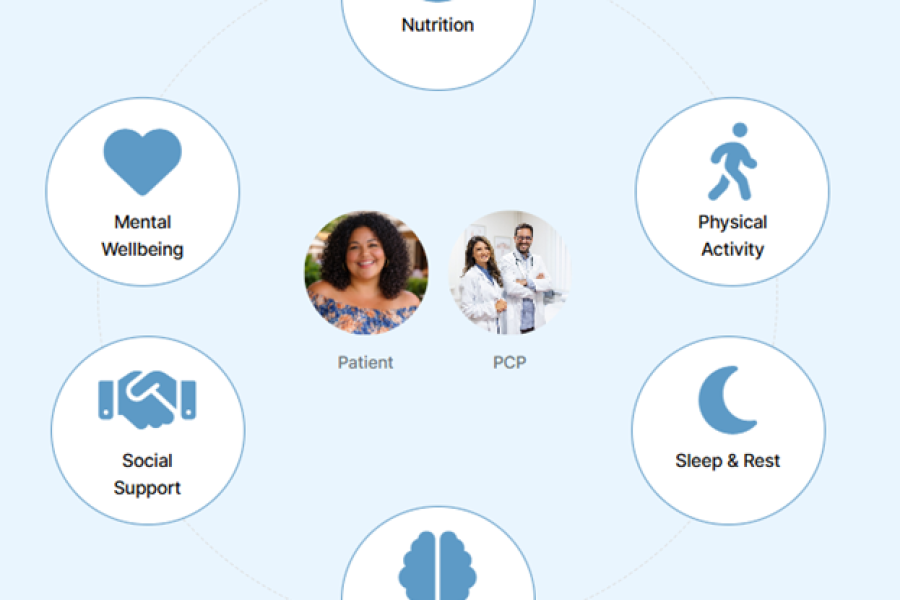
The model places the patient and primary care physician at the center, surrounded by six interconnected pillars that influence chronic disease outcomes: nutrition, movement, sleep, stress management, social connection, and behavioral support. Rather than separating these areas into disconnected recommendations, the goal is to integrate them into a more continuous support system around the patient.
What became increasingly clear through Viora’s programs was that meaningful breakthroughs often happened outside the traditional clinical encounter.
An educator might recognize that a patient’s inconsistent eating habits were connected to caregiving stress and poor sleep. A health coach might uncover transportation barriers that prevent participation in community exercise programs. Group sessions often revealed something equally important: patients struggling with similar challenges no longer felt isolated in the process of change.
These moments created a more complete picture of what patients were actually navigating day to day.
What We Have Learned Through Real-World Programs
Several funded partnerships provided real-world evidence for how integrated lifestyle medicine support can help address persistent gaps in chronic disease care.
In Viora’s CDC-funded Diabetes Prevention Program, the focus was on longitudinal engagement and accountability over time. Participants attended an average of 80% of all sessions, with 75% remaining engaged through the end of the year-long program. Participants demonstrated improvements in activity levels, blood pressure, weight, and A1C levels while also reporting increased energy, stronger accountability, and a greater sense of community support.
Another initiative focused on social determinants of health — factors like food insecurity, transportation barriers, social isolation, and limited access to community resources that can significantly affect long-term outcomes (World Health Organization).
Through Viora’s American Heart Association-funded program, participants completed social needs assessments and received individualized intervention plans connecting them with food access programs, transportation support, and local community resources.
By the end of the six-month program, all identified social determinant gaps were reported as resolved. Participants also described feeling more supported, connected, and confident throughout the process.
Personalization also became an important theme across the programs.
Many healthcare recommendations are built around ideal circumstances, but real life includes work schedules, caregiving responsibilities, cultural food preferences, language differences, stress, and financial limitations that all influence whether lifestyle changes feel realistic and sustainable.
In a Johnson & Johnson Innovation Fund-supported program, Viora explored culturally tailored wellness planning by incorporating culturally familiar foods, language preferences, and individualized routines into lifestyle support. Participants reported improvements in sleep, stress, blood glucose, blood pressure, and social support while also describing a stronger sense of understanding and personalization during care.
Technology-supported engagement became another area of exploration.
In an NIH-supported feasibility study, participants in Viora’s educator-supported, app-enabled program demonstrated significantly greater engagement and interaction compared to standard self-directed approaches. The findings reinforced something many clinicians already experience firsthand: information alone is rarely enough to sustain behavior change. Ongoing accountability, human connection, and consistent reinforcement often matter just as much (Holt-Lunstad et al., PLoS Medicine).
The Future of Whole-Person Chronic Disease Care
As healthcare continues to evolve, more attention is being placed on models that recognize how closely behavior, environment, physiology, and emotional well-being are connected.
For many patients, lasting health improvements may depend less on treating conditions individually and more on creating systems that support small, repeatable behaviors over time — with clinical care, behavioral support, and human connection working together rather than separately.
Viora Health’s Research and Partnerships
The principles discussed throughout this article have been applied across multiple Viora Health programs developed in partnership with organizations including the Centers for Disease Control and Prevention (CDC), American Heart Association (AHA), National Institutes of Health (NIH), and Johnson & Johnson Innovation.
Across these initiatives, participants demonstrated improvements in health outcomes, engagement, accountability, and social support while receiving care designed around the realities of daily life. These partnerships continue to provide valuable insight into how lifestyle medicine, behavioral support, and whole-person care can work together to address chronic disease more effectively.
You can learn more about Viora Health’s outcomes, funded initiatives, and case studies here: Our Case Studies
Partner With Viora Health
Viora Health partners with healthcare organizations, employers, health plans, and community partners to implement evidence-based lifestyle medicine programs focused on chronic disease prevention, management, and whole-person health.
Through educator-led support, technology-enabled engagement, social determinants of health interventions, and culturally tailored care models, our programs help organizations improve outcomes while supporting long-term behavior change.
Whether your organization is focused on diabetes prevention, cardiovascular health, weight management, population health, or health equity initiatives, we welcome the opportunity to explore how we can work together.
Learn more about our partnership opportunities: Partner With Us







 Objective: Received referrals from a community health center (CHC) to enroll eligible pre-diabetic participants in the National Diabetes Prevention Program (NDPP) based on their ADA risk score. Viora Program was composed of 26 virtual app-supported , educator-led group sessions over the course of one year. Impact: Patients attended on average 80% of all sessions and 75% of patients remained in the program at the end of one year. Patients lost weight, improved their activity minutes per week, and improved their blood pressure and A1C levels. They reported feeling more energized, and gaining the required structure and support to gain healthy habits and stay motivated over the year-long period. Participants formed a deep relationship-based community. Recognition: Submitted one year of weekly data to the CDC to gain CDC’s Full Recognition to Prevent and Delay Type 2 Diabetes credential.