


The Part of Chronic Disease Management Nobody Talks About Enough – Social Determinants of Health
Most people, when they think about managing diabetes or heart disease, think about food. Eat less of this, more of that. And food matters — no question. But anyone who has spent real time with Medicare patients knows that telling someone to eat more vegetables and move more is only part of the story. Sometimes it is not even close to the most important part. Here is what actually gets in the way.
It Is Not About Motivation
When a patient does not follow through on lifestyle recommendations, the easy explanation is that they are not motivated enough. But that framing misses a lot. The conditions people live in — their income, their neighborhood, whether they can afford food, whether they feel safe walking outside, or whether they are caregiving for a spouse or grandchild — shape health behaviors in ways that a 15-minute clinic visit cannot touch.
This is what social determinants of health actually means on the ground. It is not a policy concept. It is the reason why a patient nods at discharge instructions and then goes home to a situation where following them is genuinely hard.
Without accounting for those conditions, lifestyle medicine recommendations often fail to land the way they should — both for patients and for the healthcare systems trying to support them.
What Is Actually Standing in the Way
Food Access
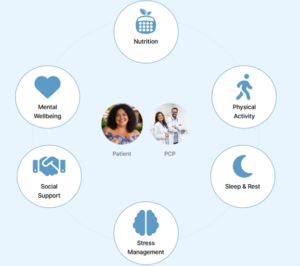
Limited access to affordable, healthy food is one of the strongest drivers of poor diet quality and chronic disease risk. In many communities healthy food is either too expensive, too far away, or both. For Medicare patients living on fixed incomes, this constraint can be constant.
Safe Movement and Physical Activity
When neighborhoods are unsafe or community facilities are limited, physical activity declines and sedentary behavior increases. This is not because people choose inactivity — it is because the environment makes healthy movement difficult or unsafe.
Sleep Disruptions
Crowded housing, financial instability, and irregular work schedules can severely disrupt sleep. For many people, poor sleep is not simply a habit problem but a direct consequence of economic and housing instability.
Chronic Financial Stress
Economic hardship affects the body over time. Persistent financial stress increases cortisol levels and creates chronic inflammation, contributing to insulin resistance, cardiovascular disease, and metabolic disorders.
Social Isolation
Loneliness and limited social support are strongly linked with higher mortality and poorer cardiometabolic health outcomes. For many older adults, social isolation is not occasional — it becomes a daily reality.
Health Literacy and Access to Care
Low health literacy and limited access to healthcare services make it difficult for patients to follow medical guidance or lifestyle recommendations. Even with strong motivation, these barriers can significantly limit long-term health improvements.
Why Medicare Patients Carry a Disproportionate Share
The Medicare population is diverse, but many beneficiaries managing conditions such as pre-diabetes, Type 2 diabetes, and cardiovascular disease are also dealing with food insecurity, housing instability, social isolation, and income limitations.
These social determinants do not simply accompany chronic illness — they actively drive it. Research consistently shows that social and environmental factors influence health outcomes more strongly than medical care alone.
For someone managing Type 2 diabetes on a fixed income in a neighborhood without a nearby grocery store, these barriers are not theoretical. They shape everyday life and health decisions.
What Actually Makes a Difference
Programs designed around the real circumstances of patients’ lives consistently perform better than those built on ideal assumptions. When social needs are addressed alongside medical care, patient engagement and long-term adherence improve significantly.
Community-based lifestyle programs that reduce barriers such as transportation, access to healthy food, or social support have demonstrated measurable improvements in chronic disease outcomes and reductions in health disparities.
The design of a program matters as much as the curriculum itself. If a program does not match someone’s schedule, language, culture, or environment, it will struggle to succeed.
Viora Health’s Research
Viora Health conducted an American Heart Association–funded study addressing social barriers among patients recruited in Philadelphia. Participants faced challenges such as food insecurity, transportation barriers, health literacy gaps, and social isolation.
Through a personalized intervention plan addressing these factors, patients reported increased confidence, stronger support systems, and significant improvements in their ability to manage health conditions.
The study was submitted to the American Heart Association’s Bernard J. Tyson Social Impact Fund. More information is available at:
viorahealth.com/our-case-studies
This Is Now a Federal Priority
The Centers for Medicare & Medicaid Services (CMS) has also recognized the importance of social determinants in chronic disease management. The MAHA ELEVATE model — Make America Healthy Again: Enhancing Lifestyle and Evaluating Value-Based Approaches Through Evidence — supports whole-person lifestyle medicine programs for Medicare beneficiaries.
These initiatives focus specifically on underserved populations and address the environmental and social factors that influence long-term health outcomes.
Partner With Viora Health
Viora Health is partnering with Medicare-enrolled clinics, Federally Qualified Health Centers (FQHCs), and health systems to implement these programs.
We serve as the lead applicant and program operator, managing grant administration, intervention delivery, and CMS reporting while clinical partners provide patient referrals and clinical oversight.
If your organization serves Medicare beneficiaries facing social barriers such as food insecurity, transportation limitations, or social isolation, we would welcome a conversation.
Learn more about the ELEVATE pilot program:
Or contact us directly at:






 Objective: Received referrals from a community health center (CHC) to enroll eligible pre-diabetic participants in the National Diabetes Prevention Program (NDPP) based on their ADA risk score. Viora Program was composed of 26 virtual app-supported , educator-led group sessions over the course of one year. Impact: Patients attended on average 80% of all sessions and 75% of patients remained in the program at the end of one year. Patients lost weight, improved their activity minutes per week, and improved their blood pressure and A1C levels. They reported feeling more energized, and gaining the required structure and support to gain healthy habits and stay motivated over the year-long period. Participants formed a deep relationship-based community. Recognition: Submitted one year of weekly data to the CDC to gain CDC’s Full Recognition to Prevent and Delay Type 2 Diabetes credential.